Imagine two coffee shops sitting side by side on the same street. Both carry a 4.3-star rating on Google. One is thriving, with a line out the door every morning. The other is struggling to fill seats by noon. The star ratings are virtually identical — so what's different? The answer lies in what customers are actually saying in their reviews, not just the number of stars they're assigning. And increasingly, savvy consumers know the difference.
We've entered an era where a single number can no longer capture the full story of a customer experience. Shoppers, diners, patients, and clients are reading deeper, scanning for themes, and making decisions based on the substance of reviews rather than the summary score. For businesses that want to keep up, understanding this shift isn't optional — it's essential.
The Declining Power of the Star Rating
For over a decade, star ratings served as a convenient shorthand. A 4.5 meant "great," a 3.0 meant "mediocre," and anything below 2.5 was a red flag. But consumer behavior has evolved significantly.
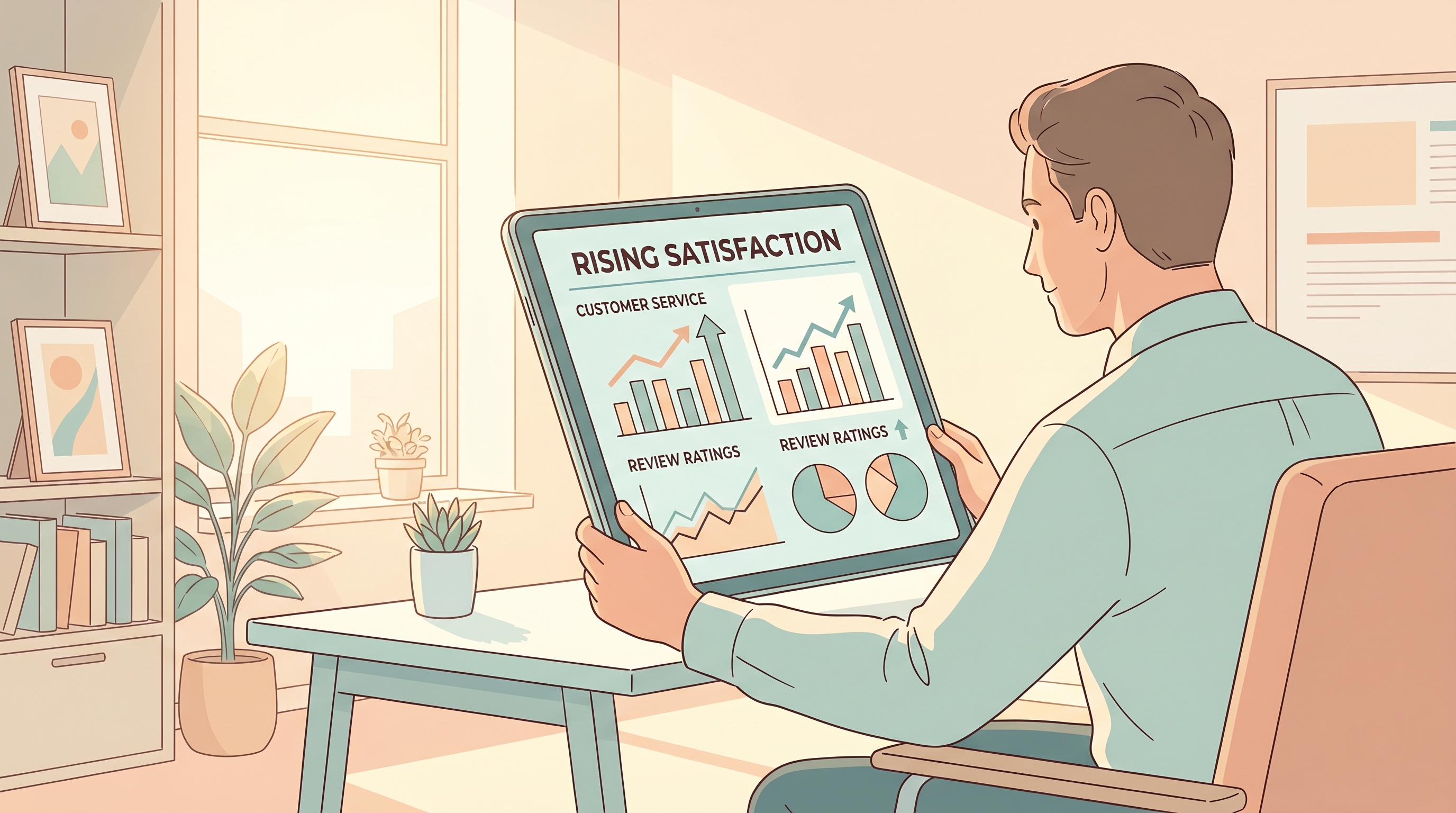
A 2023 study by BrightLocal found that only 36% of consumers consider star ratings the most important factor when evaluating a local business — down from 49% in previous years. Meanwhile, 75% of consumers reported that they always or regularly read the actual text of reviews before making a decision. By 2026, this trend has only accelerated. Consumers have become sophisticated review readers who look for patterns, not just scores.
Why the shift? Several factors are at play:
- Review inflation: Many businesses now hover between 4.0 and 4.7 stars, making it harder to differentiate based on rating alone.
- Fake review awareness: Consumers increasingly distrust perfect 5-star ratings, associating them with manipulated or incentivized reviews.
- Context dependency: A 4.2-star auto repair shop and a 4.2-star day spa tell you almost nothing about the type of experience you'll have. The details matter.
- Decision complexity: Today's consumers aren't just asking "Is this place good?" They're asking "Is this place good for what I specifically need?"
The star rating hasn't become irrelevant — it still functions as a basic filter. But it's no longer the deciding factor. The real action is happening in the review text itself.
What Consumers Are Actually Looking For
When customers scroll past the star rating and dive into review text, what are they searching for? Research from the Spiegel Research Center at Northwestern University and multiple consumer behavior studies point to several key dimensions:
1. Specific, Recurring Themes
Consumers look for patterns. A single review mentioning slow service might be an outlier. But when 30% of reviews mention wait times, it becomes a reliable signal. Customers are intuitively performing their own thematic analysis — grouping comments by topic and looking for consistency.
Common themes consumers track include:
- Service quality: Friendliness, attentiveness, professionalism
- Product or outcome quality: Did it meet expectations?
- Value perception: Was it worth the price?
- Environment and atmosphere: Cleanliness, ambiance, comfort
- Reliability and consistency: Is the experience the same every visit?
2. Emotional Tone and Sentiment
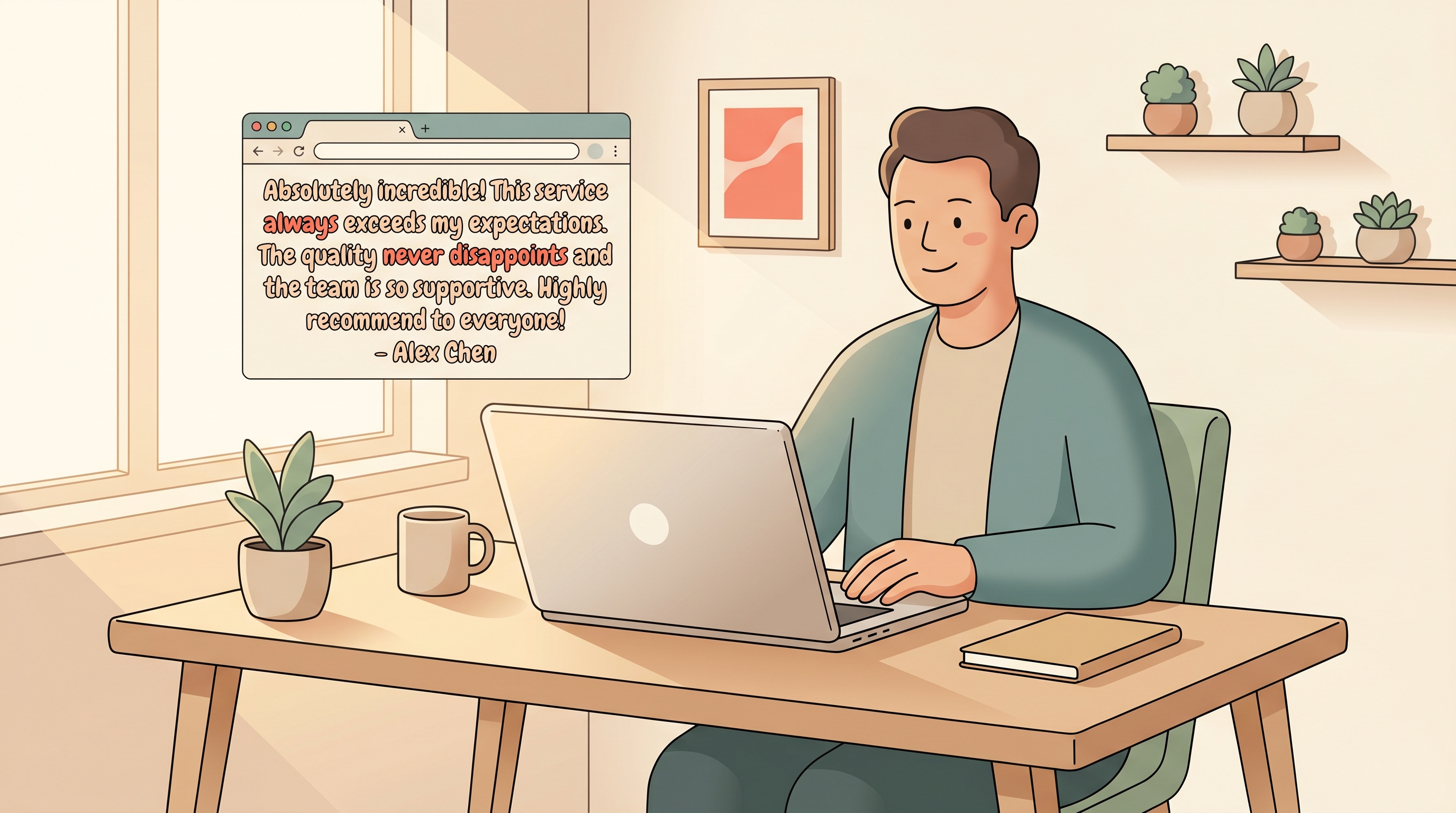
It's not just what customers say — it's how they say it. A 4-star review that reads "It was fine, nothing special" carries a very different message than a 4-star review that says "We had such a wonderful time — the only reason it's not 5 stars is the parking situation." Both are 4 stars. The sentiment couldn't be more different.
Consumers pick up on this emotional texture instinctively. They can sense enthusiasm, frustration, disappointment, and delight — and they weight these emotional signals heavily in their decisions.
3. Recency and Trend Direction
A business with a 4.5-star rating that was earned three years ago but has been sliding toward 3.8 in recent months tells a very different story than a business that started at 3.8 and has been climbing to 4.5. According to ReviewTrackers, 73% of consumers only pay attention to reviews written in the last month. The trajectory matters as much as the current score.
4. How the Business Responds
Google review data includes business owner responses, and consumers notice. A 2024 survey by Podium found that 56% of consumers said a business's response to reviews changed their perception of the business. Thoughtful, specific responses to negative reviews can actually increase trust — sometimes more than a string of perfect scores.
5. Relevance to Their Specific Situation
A parent looking for a family-friendly restaurant cares about different review details than a couple planning a date night. A patient seeking a specialist wants to know about bedside manner and wait times, not just whether the office is clean. Consumers are filtering reviews through their own personal lens, looking for signals that match their unique priorities.
The Problem: Manual Review Reading Doesn't Scale
Here's the challenge for businesses: if your customers are performing nuanced thematic analysis of your reviews, shouldn't you be doing the same — but better?
Most business owners check their star rating periodically, maybe skim a few recent reviews, and respond to the occasional complaint. But this approach misses the forest for the trees. When you have 100, 200, or 300 reviews across Google and Yelp, manually identifying themes, tracking sentiment shifts, and spotting emerging patterns is nearly impossible.
Consider the math:
- A business with 250 Google reviews averaging 80 words each has roughly 20,000 words of customer feedback to analyze.
- That's the equivalent of a short novel — written by hundreds of different authors with different priorities, writing styles, and levels of detail.
- Buried in that text are recurring themes, sentiment trends, competitive intelligence, and actionable insights that no human can reliably extract by skimming.
This is precisely where AI-powered analysis transforms the equation.
How AI-Powered Thematic Analysis Changes the Game
Modern AI — specifically large language models trained on natural language understanding — can do what human readers cannot: process hundreds of reviews simultaneously, identify statistically significant themes, quantify sentiment across categories, and surface patterns that would take a human analyst days or weeks to find.
Here's what becomes possible with AI-driven review analysis:
Structured Theme Identification
Instead of guessing what customers care about, AI can categorize every review comment into specific themes — service quality, product quality, value, experience — and tell you exactly what percentage of reviewers mention each one. This transforms anecdotal feedback into structured data.
Sentiment Scoring Beyond Stars
AI doesn't just count stars. It reads the language of every review and assigns sentiment at a granular level. A 4-star review with negative sentiment about a specific issue gets flagged differently than a 4-star review with overwhelmingly positive language. This reveals the gap between what customers rate and what they feel.
Trend Detection Over Time
By analyzing reviews chronologically, AI can identify whether specific issues are getting better or worse. Maybe your food quality scores have been climbing for six months, but your wait time complaints have doubled. A monthly trend view makes these dynamics visible.
Customer Journey Mapping
Sophisticated analysis can map sentiment across different stages of the customer journey — from initial contact and first impressions through service delivery and post-purchase follow-up. This shows you not just what's going wrong, but when it's going wrong.
Priority Matrix: Frequency Meets Severity
Not all issues are created equal. A problem mentioned in 40% of reviews with intense negative language is a five-alarm fire. A minor quibble mentioned in 5% of reviews is a nice-to-fix. AI can rank issues by both frequency and severity, giving businesses a clear roadmap for where to invest their improvement efforts.
Competitive Intelligence From Your Own Reviews
Customers frequently mention competitors in their reviews — "better than [Competitor X]" or "we switched from [Competitor Y] because..." AI can surface these mentions and analyze the context, giving you competitive positioning insights directly from customer voices.
Why Industry Benchmarks Matter More Than Ever
Understanding your own reviews is only half the picture. The other half is context. Is a 4.2-star rating good for your industry? What about your sentiment breakdown — is 72% positive typical, or are you lagging behind?
Industry benchmarks derived from large-scale review data — across thousands of businesses and millions of reviews — provide the context that makes your own data meaningful. Without benchmarks, you're flying blind. With them, you can see exactly where you stand relative to your peers and where the biggest opportunities for differentiation lie.
For example, if the median rating for restaurants in your category is 4.1 and you're at 4.3, you're performing above average. But if your sentiment around "value" is in the bottom quartile while your competitors are excelling there, you've identified a specific vulnerability that your star rating alone would never reveal.
Turning Insights Into Action
The ultimate value of deep review analysis isn't the analysis itself — it's what you do with it. Businesses that move beyond star ratings and into thematic, sentiment-driven understanding of their reviews can:
- Prioritize improvements based on data, not gut feeling — Fix what customers actually care about most, not what you think they care about.
- Amplify proven strengths in marketing — If 65% of reviewers praise your staff by name, that's a differentiator worth promoting.
- Identify quick wins with outsized impact — Some fixes are simple but affect a large percentage of reviews. These are your highest-ROI improvements.
- Track the impact of changes over time — Run a new report after implementing changes to see whether sentiment has shifted.
- Understand your competitive position through the customer's eyes — Not through market research surveys, but through unsolicited, authentic customer feedback.
Getting Started With Deeper Review Analysis
If you're ready to move beyond star ratings and understand what your customers are truly saying, Zabble Insights offers AI-powered analysis of your Google Reviews and Yelp Reviews, delivered as a professional report with actionable recommendations and industry benchmarks.
Each report analyzes up to 300 reviews per source, identifies key themes and sentiment patterns, maps your performance against benchmarks drawn from approximately 4 million reviews across 22 business categories, and provides a prioritized list of strategic recommendations — complete with direct customer quotes as evidence. Reports are delivered as professionally formatted Word documents, starting at $99 per business.
It's a one-time snapshot designed to give you clarity on where you stand and what to do next — based entirely on what your real customers are already telling you.
Frequently Asked Questions
Do star ratings still matter for local businesses?
Yes, star ratings still matter — but they function primarily as a filter rather than a decision driver. Most consumers use star ratings to narrow their options (for example, eliminating anything below 3.5 stars), but then read actual review text to make their final choice. Research from BrightLocal shows that 75% of consumers regularly read review content, not just ratings. Businesses should aim for a strong star rating as a baseline, but understand that the themes, sentiment, and specific details within reviews are what ultimately drive customer decisions in 2026.
What is thematic analysis of customer reviews?
Thematic analysis of customer reviews is the process of identifying recurring topics, patterns, and subjects across a large body of review text. Instead of reading reviews one by one, thematic analysis groups comments into categories — such as service quality, product quality, value, and atmosphere — and quantifies how frequently each theme appears and whether the sentiment around it is positive, negative, or neutral. When performed by AI across hundreds of reviews, thematic analysis reveals statistically significant patterns that manual reading would miss, giving businesses a data-driven understanding of their customers' priorities and pain points.
How do consumers use review details to make purchasing decisions?
Consumers in 2026 approach reviews like investigators. They scan for recurring themes ("multiple people mention long wait times — that's probably real"), assess emotional tone (enthusiasm vs. lukewarm acceptance), check recency (prioritizing reviews from the last few months), evaluate business responses to complaints, and filter for relevance to their specific needs. A parent choosing a pediatric dentist reads reviews differently than an adult seeking cosmetic dentistry — same practice, different decision criteria. This sophisticated reading behavior means businesses need to understand not just their overall score, but the specific narratives emerging from their review ecosystem.
Can AI really understand the nuances of customer reviews?
Modern AI language models like GPT-4.1 are remarkably effective at understanding context, tone, sarcasm, and nuance in customer reviews. They can distinguish between a 4-star review that's genuinely enthusiastic and one that's passively disappointed. They can identify when a customer is comparing a business to a competitor, when a compliment is backhanded, and when a complaint is about a one-time issue versus a systemic problem. While no AI is perfect, the ability to process hundreds of reviews simultaneously and identify patterns across the full dataset produces insights that are both more comprehensive and more reliable than any individual human reading session could achieve.