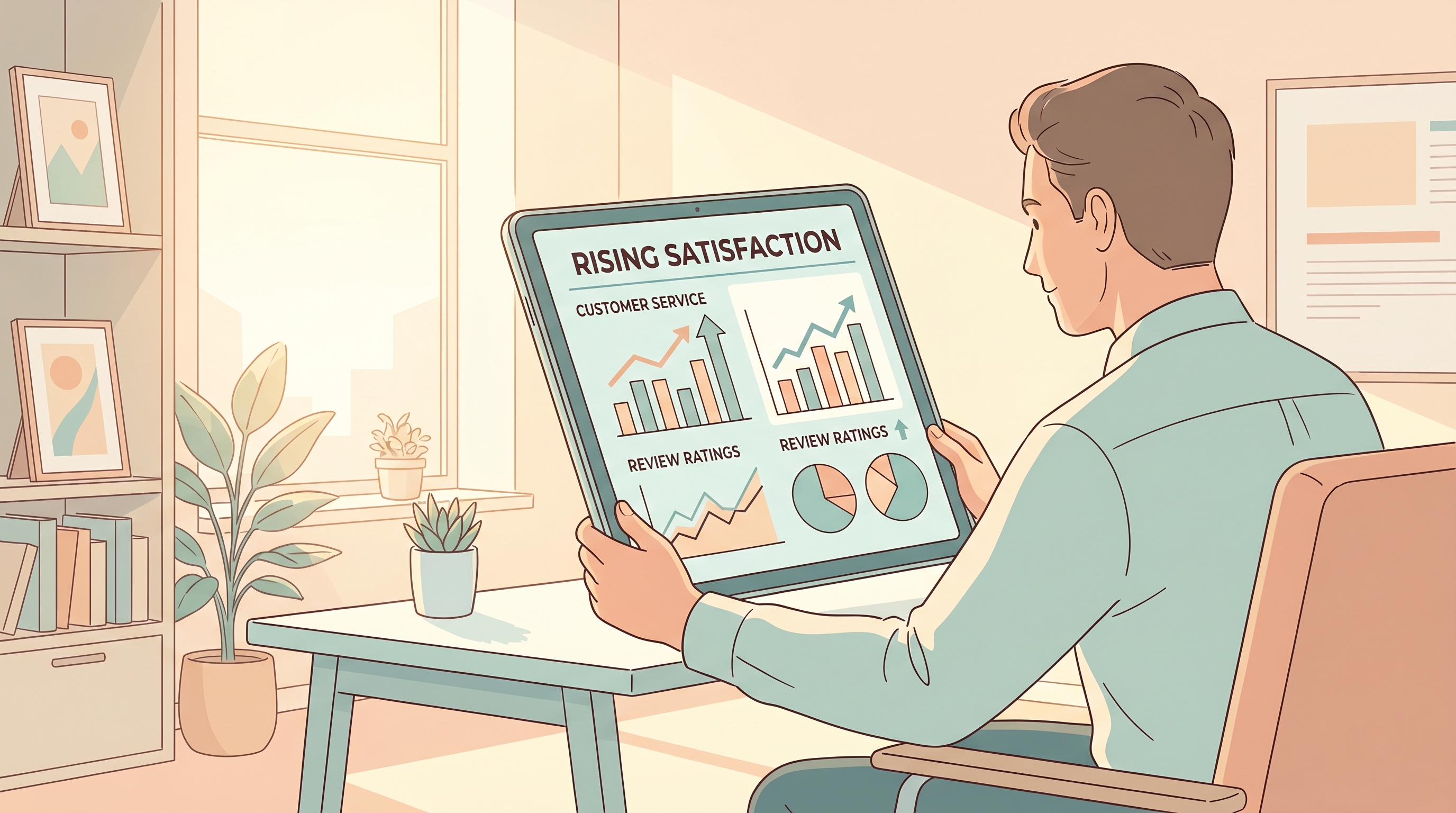
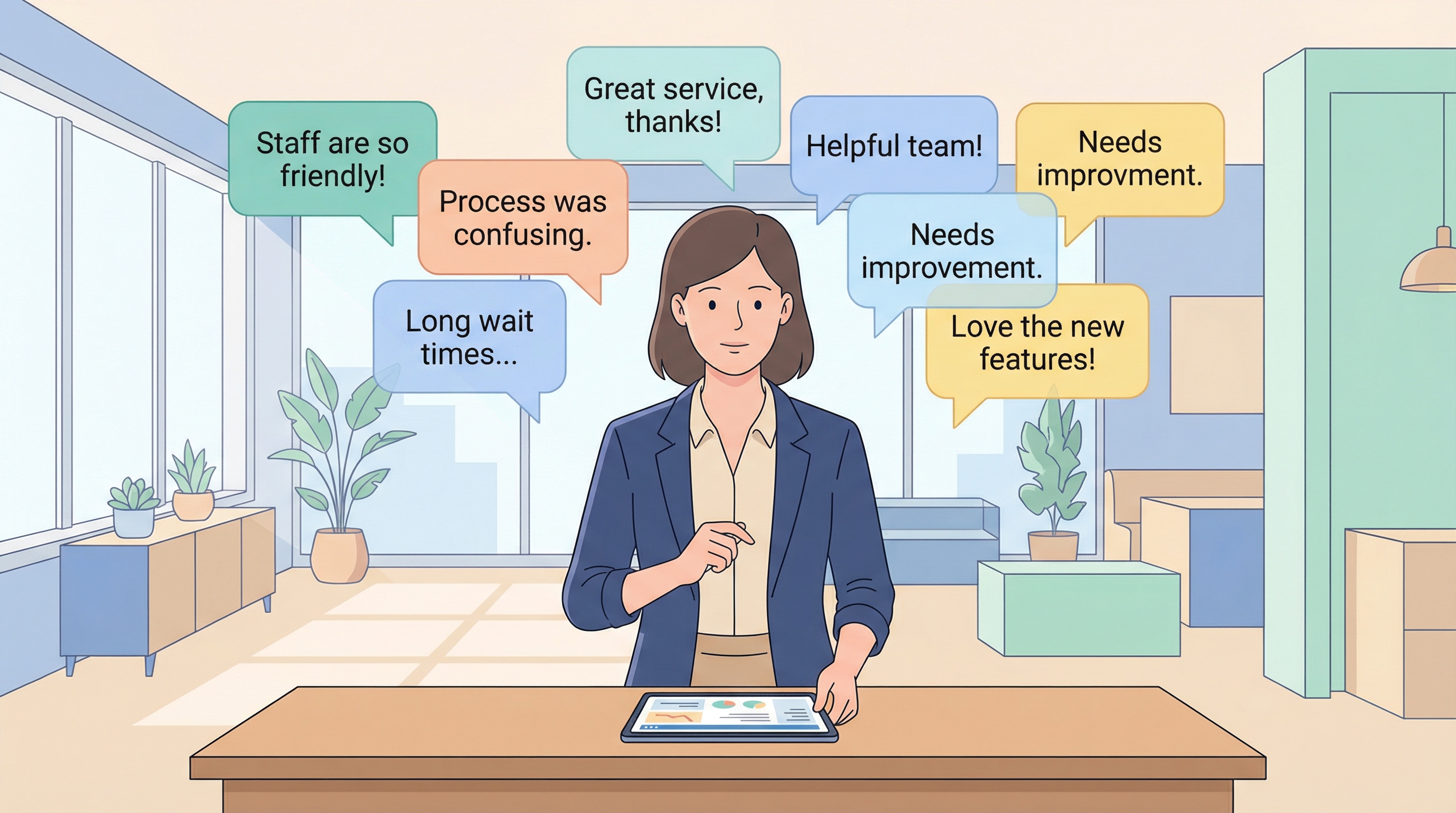
Every review your customers leave is a tiny confession. Not just about what happened during their visit, but about what they expected to happen—and where reality fell short or exceeded those expectations. Buried inside the language of thousands of Google and Yelp reviews are evolving standards that most businesses never consciously detect. A shift from praising "friendly staff" to demanding "personalized service." A move from accepting "reasonable wait times" to expecting "instant acknowledgment." These aren't random complaints. They're signals of a customer expectation revolution—and AI-driven thematic analysis is the key to decoding them.
The Expectation Gap Is Widening—and Reviews Prove It
Customer expectations aren't static. According to Salesforce's 2024 State of the Connected Customer report, 65% of customers say they expect companies to adapt to their changing needs and preferences, yet only 29% feel that companies generally meet that bar. That 36-point gap isn't just a survey statistic—it plays out in real language, in real reviews, every single day.
Consider what's happened in just the past few years:
- Speed expectations have compressed. A 2023 HubSpot study found that 90% of customers rate an "immediate" response as important when they have a customer service question, with 60% defining "immediate" as 10 minutes or less.
- Personalization is now baseline. McKinsey's 2023 research showed that 71% of consumers expect personalized interactions, and 76% get frustrated when this doesn't happen.
- Transparency is non-negotiable. PwC's Global Consumer Insights Survey found that 73% of consumers point to experience as a key factor in purchasing decisions, with honest communication ranking among the top drivers of trust.
These macro trends are well documented. But the real question for any individual business owner is: How are these shifting expectations showing up in my reviews, for my business, in my market?
That's where the hidden insights live.
How Reviews Encode Customer Expectations
Most businesses read reviews for surface-level feedback: Was the customer happy or unhappy? Did they mention a specific employee? Was the food good?
But reviews contain far richer data than a star rating and a thumbs-up. They encode implicit expectations—the standards customers hold but rarely articulate directly. Understanding these requires looking at patterns across dozens or hundreds of reviews, not individual anecdotes.
The Language of Rising Standards
When customers write things like:
- "The food was fine but the whole experience felt impersonal"
- "I expected more for what I paid"
- "Other places in the area have really raised the bar"
- "It's 2025—why is this still so complicated?"
...they're not just complaining. They're benchmarking your business against an evolving mental model of what "good" looks like. Each of these phrases carries an implicit expectation:
- "Impersonal" → The customer expected personalization or recognition.
- "More for what I paid" → Value perception has shifted; quality alone isn't enough without perceived fairness.
- "Raised the bar" → Competitors are actively resetting expectations in your market.
- "It's 2025" → Technology and convenience standards are time-stamped in customers' minds.
Manually spotting these patterns across 200 or 300 reviews is virtually impossible. But AI-driven thematic analysis can surface them systematically, clustering language into themes and tracking how those themes shift over time.
Five Hidden Expectations AI Thematic Analysis Reveals
When you apply AI-powered analysis to a large corpus of Google and Yelp reviews, several categories of hidden expectations consistently emerge. Here are the five most common—and most actionable.
1. The Expectation of Proactive Communication
Customers increasingly expect businesses to anticipate their needs rather than react to problems. Reviews that mention "no one told me," "I had to ask," or "I wish they had mentioned" all point to this expectation.
What the data shows: Thematic clusters around communication failures often correlate with 2- and 3-star reviews—not 1-star reviews. This means proactive communication isn't what separates terrible experiences from acceptable ones; it's what separates acceptable from excellent. Businesses that miss this signal plateau at 3.5–4.0 stars and can't figure out why.
2. The Expectation of Consistency
One of the most powerful patterns in review analysis is the "inconsistency complaint." Phrases like "hit or miss," "depends on who you get," and "last time was great but this time..." reveal that customers now expect every interaction to meet the same standard.
A 2024 Qualtrics XM Institute study found that consistency is one of the top three drivers of customer loyalty across industries. Reviews make this tangible: when AI analysis identifies a high variance in sentiment around the same topic (e.g., service speed praised in 40% of reviews but criticized in 25%), it reveals an operational consistency problem that aggregate ratings alone would mask.
3. The Expectation of Emotional Recognition
This is one of the most rapidly evolving expectations. Customers don't just want their problem solved—they want to feel heard. Reviews increasingly use emotional language:
- "They made me feel like I didn't matter"
- "She actually listened"
- "I felt rushed out the door"
AI sentiment analysis can distinguish between reviews that criticize a functional failure ("the order was wrong") and those that describe an emotional failure ("they didn't seem to care that the order was wrong"). The latter category is growing, and it disproportionately drives 1-star reviews and negative word-of-mouth.
4. The Expectation of Digital-Physical Parity
Customers now expect their in-person experience to match the polish of a business's online presence. When a beautifully designed website leads to a disorganized in-store experience, reviews reflect the dissonance:
- "Based on their website I expected something more upscale"
- "The online booking was easy but the actual appointment was chaotic"
- "Their Instagram makes it look amazing but in reality..."
Thematic analysis of Google and Yelp reviews can surface this expectation gap by identifying clusters of reviews that reference a business's online presence alongside in-person disappointment. This is a uniquely modern expectation that didn't exist a decade ago.
5. The Expectation of Value Transparency
Price sensitivity hasn't increased—value opacity intolerance has. Customers are willing to pay premium prices, but they expect to understand exactly what they're paying for. Reviews that mention "hidden fees," "didn't realize it would cost extra," or "not worth the price" aren't always about the dollar amount. They're about the gap between expected and actual value.
AI analysis can quantify this by tracking the frequency and severity of value-related complaints and cross-referencing them with overall sentiment. A business might have strong product quality scores but a declining value perception—a leading indicator of customer attrition that star ratings alone won't reveal.
From Hidden Expectations to Strategic Action
Identifying these patterns is only valuable if it leads to action. Here's a framework for translating hidden expectations into business improvements:
Step 1: Quantify the Signal
Don't act on a single review. Look for themes that appear in 10% or more of your reviews. AI-driven analysis can assign frequency and severity scores to each theme, helping you prioritize.
Step 2: Map Expectations to the Customer Journey
Hidden expectations often cluster around specific journey stages:
- Pre-purchase: Expectations about information availability, booking ease, and responsiveness
- During the experience: Expectations about personalization, speed, and emotional tone
- Post-purchase: Expectations about follow-up, issue resolution, and loyalty recognition
Analyzing reviews through this lens reveals exactly where in the journey you're losing ground.
Step 3: Benchmark Against Your Industry
An expectation that seems unreasonable in isolation might be perfectly standard in your category. If the median rating for restaurants in your area is 4.3 and you're sitting at 3.9, the gap likely reflects unmet expectations that competitors are already addressing. Industry benchmarking—based on real review data, not assumptions—provides essential context.
Step 4: Prioritize Quick Wins
Some hidden expectations can be addressed immediately:
- Adding proactive communication scripts for staff
- Clarifying pricing on menus, websites, or signage
- Standardizing service protocols to reduce inconsistency
Others require longer-term investment (facility upgrades, technology adoption, culture change). A well-structured analysis separates these into actionable tiers.
Step 5: Track the Shift
Expectations evolve. What customers demanded in 2023 may be table stakes by 2025, and new expectations will have emerged. Periodic analysis of your review corpus—not just checking your star rating—lets you detect these shifts before they become crises.
Why This Matters More Than Ever
The businesses that thrive in competitive markets aren't necessarily the ones with the best product or the lowest price. They're the ones that understand what their customers expect—and evolve faster than those expectations change.
Reviews are the most honest, unsolicited, and detailed source of customer expectation data available to any business. Unlike surveys (which suffer from response bias) or focus groups (which suffer from small sample sizes), reviews capture what customers actually felt strongly enough to write about, in their own words, unprompted.
The challenge has always been scale: reading 300 reviews and synthesizing the patterns is a full-time job. AI-driven thematic analysis solves that problem, turning raw review text into structured, actionable intelligence.
Uncover What Your Customers Really Expect
If you're ready to look beyond star ratings and discover the hidden expectations embedded in your customer reviews, Zabble Insights can help. Our AI-powered platform analyzes up to 300 of your Google Reviews (with an optional Yelp add-on) and delivers a professional report that includes thematic analysis, sentiment breakdowns, customer journey mapping, and strategic recommendations—all benchmarked against real industry data from over 6,600 businesses and nearly 4 million reviews. Each report is a detailed snapshot of what your customers truly expect, backed by their own words and quantified by frequency and severity.
Explore sample reports at zabbleinsights.com to see the depth of analysis available for your business.
Frequently Asked Questions
How do customer reviews reveal hidden expectations?
Customer reviews contain implicit expectations encoded in the language customers use. Phrases like "I expected more," "other places do this better," or "no one told me" signal specific standards the customer held before their experience. When AI-powered thematic analysis processes hundreds of reviews at once, it clusters these phrases into recurring themes—such as proactive communication, consistency, or value transparency—and quantifies how often each theme appears and how severely it impacts satisfaction. This turns scattered feedback into a structured map of what customers actually demand.
What types of customer expectations are most commonly hidden in Google and Yelp reviews?
The five most common hidden expectations found through AI analysis of Google and Yelp reviews are: (1) proactive communication—customers expect to be informed before problems arise; (2) consistency—every visit should meet the same standard; (3) emotional recognition—customers want to feel heard, not just served; (4) digital-physical parity—the in-person experience should match the online brand; and (5) value transparency—customers tolerate premium pricing but not hidden costs or unclear value. These expectations often drive the difference between 3-star and 5-star ratings.
How is AI thematic analysis different from just reading reviews?
Manually reading reviews gives you anecdotes; AI thematic analysis gives you patterns. A human reading 200 reviews might notice a few recurring complaints, but AI can systematically categorize every review across 20+ dimensions, assign sentiment scores, track frequency and severity of each theme, identify shifts over time, and cross-reference findings against industry benchmarks. This transforms subjective impressions into data-driven insights that support strategic decision-making.
How often should a business analyze its reviews for shifting customer expectations?
Customer expectations evolve continuously, influenced by competitor improvements, technology adoption, and broader cultural shifts. While there's no universal cadence, periodic review analysis—such as quarterly or semi-annually—helps businesses detect emerging expectations before they become widespread complaints. Each analysis serves as a snapshot that captures the current state of customer sentiment, allowing businesses to compare against previous periods and track whether their improvements are resonating with customers.