Most businesses say they're customer-centric. Very few actually are. The difference between the two isn't intention—it's information. Companies that truly organize around customer needs have found a way to systematically listen, interpret, and act on what their customers are telling them. And for the vast majority of local and mid-size businesses, the richest source of unfiltered customer intelligence is hiding in plain sight: your Google and Yelp reviews.
Harvard Business Review has long championed the idea that customer-centricity isn't just a philosophy—it's an operational framework. It requires businesses to shift from product-first or operations-first thinking to a model where customer value drives every decision, from staffing to service design to pricing. The challenge has always been knowing what customers actually value most. Reviews solve that problem—if you know how to read them.
This post will show you how to extract the strategic signals buried in your review data, and how to use those signals to restructure your business around what matters most to the people who keep you in business.
The Customer-Centricity Gap: Why Good Intentions Aren't Enough
A 2024 study by PwC found that 73% of consumers point to customer experience as an important factor in their purchasing decisions, yet only 49% of U.S. consumers say companies provide a good customer experience. That gap—between what businesses think they're delivering and what customers actually perceive—is the customer-centricity gap.
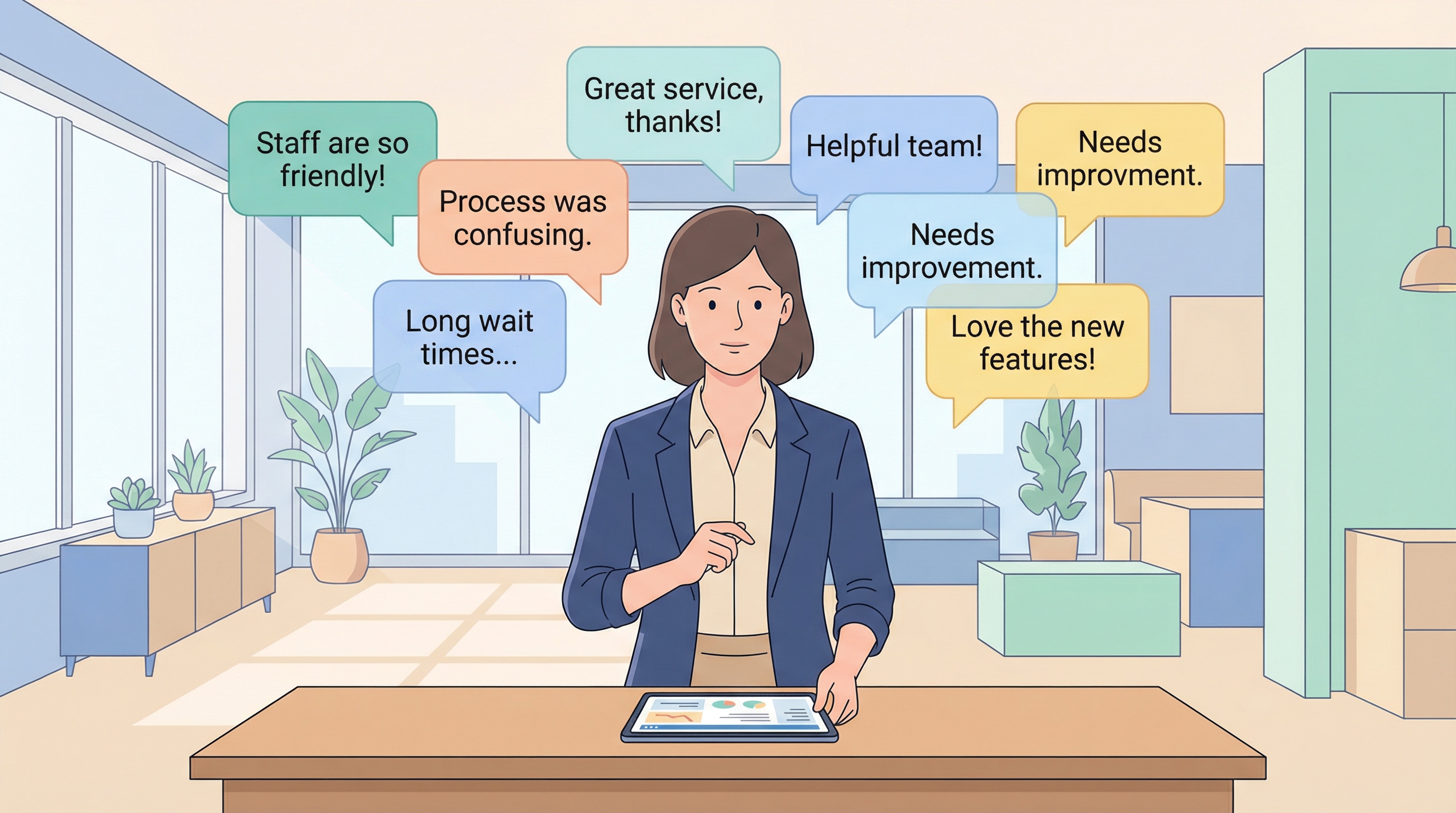
The problem isn't a lack of caring. It's a lack of structured feedback interpretation. Most business owners read their reviews one at a time, reacting emotionally to individual comments rather than analyzing them as a dataset. They celebrate the five-star raves and agonize over the one-star complaints, but they rarely step back to ask:
- What themes repeat across dozens or hundreds of reviews?
- Which aspects of my business generate the strongest positive sentiment—and which generate the most friction?
- How does my performance compare to industry benchmarks?
- Where in the customer journey am I losing people?
These are the questions that transform reviews from anecdotal noise into strategic intelligence.
Why Google and Yelp Reviews Are Your Best Customer Research
Before diving into frameworks, it's worth understanding why reviews are uniquely valuable as a customer-centricity data source.
Reviews Are Unsolicited and Unstructured
Unlike surveys—where you choose the questions and often bias the answers—reviews capture what customers choose to talk about. When someone writes a review, they're telling you what mattered most to them, in their own words. That self-selection is analytically powerful. If 40% of your reviews mention wait times, that's not because you asked about wait times. It's because wait times are a defining part of your customer experience.
Reviews Capture the Full Spectrum
According to BrightLocal's 2024 Local Consumer Review Survey, 75% of consumers "always" or "regularly" read online reviews when browsing for local businesses. Your reviews represent a cross-section of your customer base—loyal regulars, first-time visitors, and everyone in between. That breadth gives you a more representative picture than any focus group.
Reviews Are Longitudinal
With two to three years of review history, you can track how customer sentiment shifts over time. Did a new menu launch improve food quality mentions? Did a staffing change correlate with more complaints about service speed? Time-series review data reveals the impact of your operational decisions.
The Framework: Four Pillars of Review-Driven Customer-Centricity
Inspired by HBR's customer-centricity principles, here's a practical four-pillar framework for using review analysis to restructure your business around customer value.
Pillar 1: Sentiment Theme Mapping
The first step is moving beyond star ratings to understand the themes driving customer sentiment. A 4.2-star average tells you almost nothing about what to do next. But knowing that 62% of your positive reviews praise your staff's friendliness while 38% of your negative reviews cite inconsistent product quality—that's actionable.
How to apply this:
- Identify your top 3-5 positive sentiment themes. These are your brand pillars—the things customers love that you should protect, amplify, and market.
- Identify your top 3-5 negative sentiment themes. These are your improvement priorities. Rank them by frequency (how often they appear) and severity (how much they impact star ratings).
- Look for contradictions. If some customers praise your ambiance while others complain about noise, you may have a segmentation issue—different customer types with different needs.
This thematic mapping replaces gut feeling with evidence. Instead of guessing what customers care about, you know.
Pillar 2: Customer Journey Stage Analysis
Not all friction points are created equal. A problem during the discovery or booking phase has a different strategic implication than a problem during the core service delivery or post-purchase follow-up.
Review text naturally maps to customer journey stages:
- Pre-purchase: Comments about your website, booking process, phone responsiveness, or first impressions
- Arrival/onboarding: Mentions of parking, wait times, check-in processes, or initial greeting
- Core experience: The product or service itself—quality, consistency, expertise, value
- Post-purchase: Follow-up communication, issue resolution, loyalty rewards, or willingness to return
How to apply this:
- If your core experience scores are strong but pre-purchase friction is high, you're losing customers before they ever experience your best work. Fix the front door.
- If your core experience is inconsistent but your post-purchase recovery is excellent, you're spending resources on damage control instead of prevention. Invest upstream.
- If customers rave about the experience but never mention returning or recommending, you may have a retention gap that marketing alone can't fix.
Mapping sentiment to journey stages reveals where in the customer relationship your brand is strongest and weakest—and that changes your investment priorities.
Pillar 3: Category Performance Benchmarking
Customer-centricity doesn't exist in a vacuum. Your customers are comparing you—consciously or not—to every other business in your category. What feels like "good enough" service quality might actually be below the median for your industry.
Category performance scoring evaluates your business across dimensions like:
- Service quality — responsiveness, expertise, friendliness
- Product quality — consistency, value, presentation
- Value perception — price-to-quality ratio
- Overall experience — ambiance, convenience, emotional resonance
When you benchmark these scores against industry data, the picture sharpens dramatically. For example, a restaurant with a 4.3-star average might feel confident—until benchmarking reveals that the 75th percentile for restaurants in their category is 4.5, and their service quality sub-score is in the bottom quartile.
How to apply this:
- Outperforming benchmarks in a category? Double down. This is your competitive moat. Feature it in marketing.
- Underperforming benchmarks? This is where customer expectations are being violated. Prioritize improvement here, because customers are implicitly comparing you to competitors who do it better.
- At parity with benchmarks? This is table stakes. You won't win on this dimension, but you can't afford to slip.
Pillar 4: Strategic Prioritization With a Customer Priority Matrix
The final pillar brings it all together. A customer priority matrix plots issues by frequency (how often they appear in reviews) and severity (how negatively they impact sentiment and ratings), creating four quadrants:
| High Frequency | Low Frequency | |
|---|---|---|
| High Severity | 🔴 Critical — Fix immediately | 🟡 Hidden risks — Monitor closely |
| Low Severity | 🟠 Persistent irritants — Plan fixes | 🟢 Minor issues — Address opportunistically |
How to apply this:
- Critical issues (high frequency + high severity) are your top priority. These are the themes that appear in many reviews and significantly damage your ratings. Every week you delay costs you customers.
- Persistent irritants (high frequency + low severity) are the paper cuts that erode satisfaction over time. They rarely trigger a one-star review on their own, but they prevent five-star reviews.
- Hidden risks (low frequency + high severity) are the landmines. They don't happen often, but when they do, they generate the kind of detailed, scathing reviews that prospective customers read and remember.
- Minor issues can be addressed as resources allow.
This matrix transforms a potentially overwhelming list of customer complaints into a clear, prioritized action plan.
Putting It Into Practice: A Real-World Example
Consider a mid-size dental practice with 200 Google reviews and a 4.1-star average. Without analysis, the owner knows patients generally like the practice but feels stuck below 4.5 stars.
A structured review analysis might reveal:
- Sentiment themes: 71% of positive reviews mention the dentist's gentle technique and clear explanations. 45% of negative reviews cite long wait times; 28% mention billing confusion.
- Journey stage analysis: Pre-purchase sentiment is strong (easy booking, friendly phone staff). Core experience is polarized (great clinical care, but wait times frustrate). Post-purchase is weak (billing issues, lack of follow-up).
- Benchmark comparison: Clinical quality scores are in the 80th percentile for dental practices. Wait time and administrative scores are in the 30th percentile.
- Priority matrix: Wait times are critical (high frequency, high severity). Billing confusion is a persistent irritant. A rare but severe theme involves insurance claim errors.
The strategic path becomes clear: protect the clinical excellence that patients love, invest in operational efficiency to reduce wait times, and overhaul billing communication. That's a customer-centric strategy built on evidence, not assumption.
From Insight to Action: Making Reviews Your Strategic Compass
The businesses that win on customer experience aren't the ones with the biggest budgets. They're the ones that listen most carefully and respond most strategically. Here's how to make review analysis an ongoing part of your strategic process:
- Establish a baseline. Analyze your current review corpus to understand where you stand across sentiment themes, journey stages, and category benchmarks.
- Identify your top three priorities. Use the customer priority matrix to focus resources where they'll have the greatest impact on customer perception.
- Make changes and measure. Implement improvements, then analyze a fresh batch of reviews in 3-6 months to see if the themes shift.
- Communicate what you've learned. Share insights with your team. When staff understand what customers value most—backed by actual quotes from real reviews—alignment improves dramatically.
- Use strengths in your marketing. If your reviews consistently praise a specific aspect of your business, that's your positioning. Let customers write your marketing copy for you.
How Zabble Insights Can Help
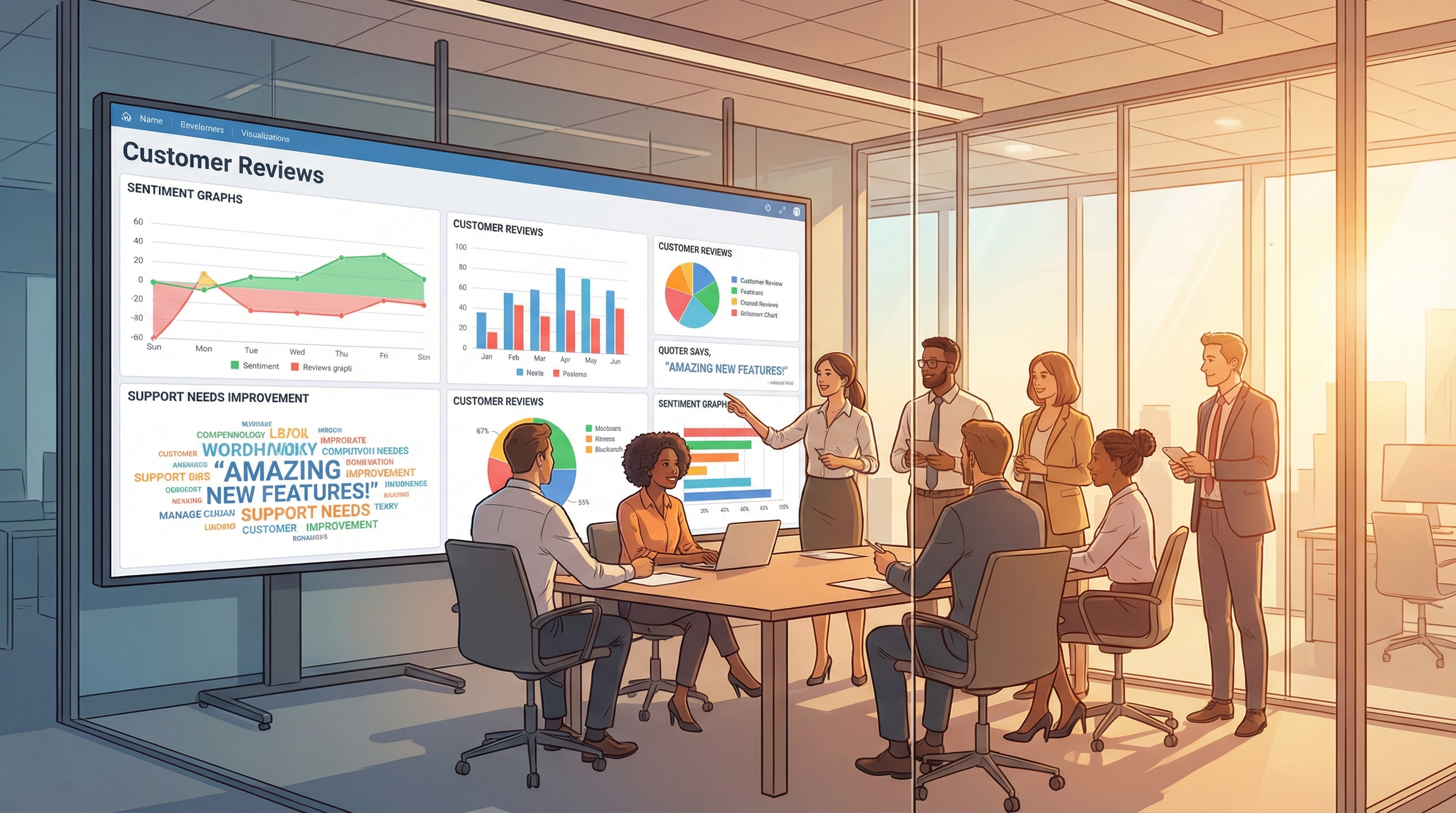
Extracting these insights manually from hundreds of reviews is time-consuming and prone to bias. That's where Zabble Insights comes in. Zabble uses AI-powered analysis of your Google and Yelp reviews to generate a comprehensive professional report—15 to 20 pages of sentiment analysis, customer journey mapping, category performance scores, thematic breakdowns, and a prioritized customer priority matrix, all benchmarked against industry data from over 22 business categories and approximately 4 million reviews.
Each report includes direct customer quotes as evidence, strategic recommendations ranked by impact, and monthly trend analysis showing how your performance has shifted over time. It's a one-time, in-depth snapshot that gives you the clarity to make customer-centric decisions with confidence—starting at $99 per business.
Explore sample reports and see how your business compares at zabbleinsights.com.
Frequently Asked Questions
How can Google and Yelp reviews help me build a customer-centric business?
Google and Yelp reviews contain unsolicited, unstructured feedback where customers describe what mattered most to them in their own words. By analyzing the themes, sentiment patterns, and frequency of specific topics across dozens or hundreds of reviews, you can identify what customers truly value—and where your business falls short. This evidence-based approach replaces assumptions with data, allowing you to restructure operations, training, and marketing around actual customer priorities rather than internal guesses.
What is a customer priority matrix and how does it work?
A customer priority matrix is a strategic tool that plots customer issues on two axes: frequency (how often an issue appears in reviews) and severity (how negatively it impacts customer sentiment and star ratings). Issues that are both frequent and severe are your most critical priorities. Issues that are frequent but low severity are persistent irritants worth addressing over time. This framework helps business owners allocate limited resources where they'll have the greatest positive impact on customer experience.
How many reviews do I need for meaningful analysis?
While even a small number of reviews can surface individual insights, meaningful pattern analysis typically requires at least 80 to 100 reviews. At this volume, recurring themes become statistically distinguishable from one-off complaints, and sentiment trends across categories like service quality, product quality, and value become reliable. Businesses with 150 to 300 reviews from the past two to three years will get the most robust and actionable analysis.
How often should I analyze my reviews for strategic insights?
For most businesses, a thorough review analysis every three to six months strikes the right balance. This cadence gives you enough time to implement changes from your previous analysis and accumulate enough new reviews to measure the impact. If you've recently made a major operational change—a new menu, a renovation, a staffing overhaul—analyzing reviews three months after the change can reveal whether customers have noticed and how their sentiment has shifted.