Fortune 500 companies spend millions on customer intelligence platforms, data science teams, and enterprise analytics suites. Meanwhile, the average small business owner is making critical decisions based on gut instinct, a quick scroll through their latest Google reviews, and maybe a conversation or two with a regular customer. The data gap between big business and small business has never been wider—but it doesn't have to be. The truth is, small businesses are already sitting on a goldmine of structured, analyzable customer data. It lives in the reviews your customers leave on Google and Yelp every single day.
The question isn't whether small businesses have access to data. It's whether they know how to extract actionable intelligence from it.
The Small Business Data Problem
Small businesses face a paradox. According to a 2023 survey by the U.S. Chamber of Commerce, 75% of small business owners say they rely on customer feedback to make business decisions. Yet a Salesforce report found that only 33% of small businesses feel confident they're using data effectively. The disconnect is clear: business owners know feedback matters, but they lack the tools and frameworks to turn raw reviews into strategic insights.
Enterprise companies solve this with dedicated analytics teams, expensive SaaS subscriptions, and custom dashboards. For a business with 5 to 50 employees, that's simply not realistic. The average small business operates on tight margins, and a $50,000-per-year analytics platform isn't in the budget.
But here's what most small business owners overlook: Google and Yelp reviews are structured data. Every review contains a numerical rating, a date, written text with sentiment and thematic content, and often a business response. When you have 80 to 300 of these reviews accumulated over time, you have a dataset rich enough to reveal patterns that can genuinely transform how you operate.
Why Review Data Is the Most Underused Asset in Small Business
Review data is unique because it's unsolicited, public, and inherently customer-centric. Unlike survey data (which suffers from low response rates and selection bias), reviews are written voluntarily by customers who feel strongly enough about their experience to share it. That emotional charge is precisely what makes review data so valuable—it captures what customers truly care about.
Consider what a single Google or Yelp review typically contains:
- A star rating — quantifiable satisfaction measurement
- Written feedback — qualitative detail about specific experiences
- A timestamp — enabling trend analysis over weeks, months, and years
- Thematic content — mentions of staff, pricing, wait times, product quality, ambiance, and more
- Competitive context — customers often reference competitors directly in their reviews
Multiply that by 100 or 200 reviews, and you have a dataset that can answer questions like:
- Is customer satisfaction trending up or down over the past 12 months?
- What are my business's top three strengths according to actual customers?
- What operational issue appears most frequently in negative reviews?
- How do I compare to the industry average for businesses like mine?
- At what stage of the customer journey are people most likely to have a negative experience?
These are the same questions that enterprise companies spend six figures to answer. The data to answer them for a small business is already sitting in plain sight.
Five Types of Analytics Every Small Business Should Extract from Reviews
1. Sentiment Analysis
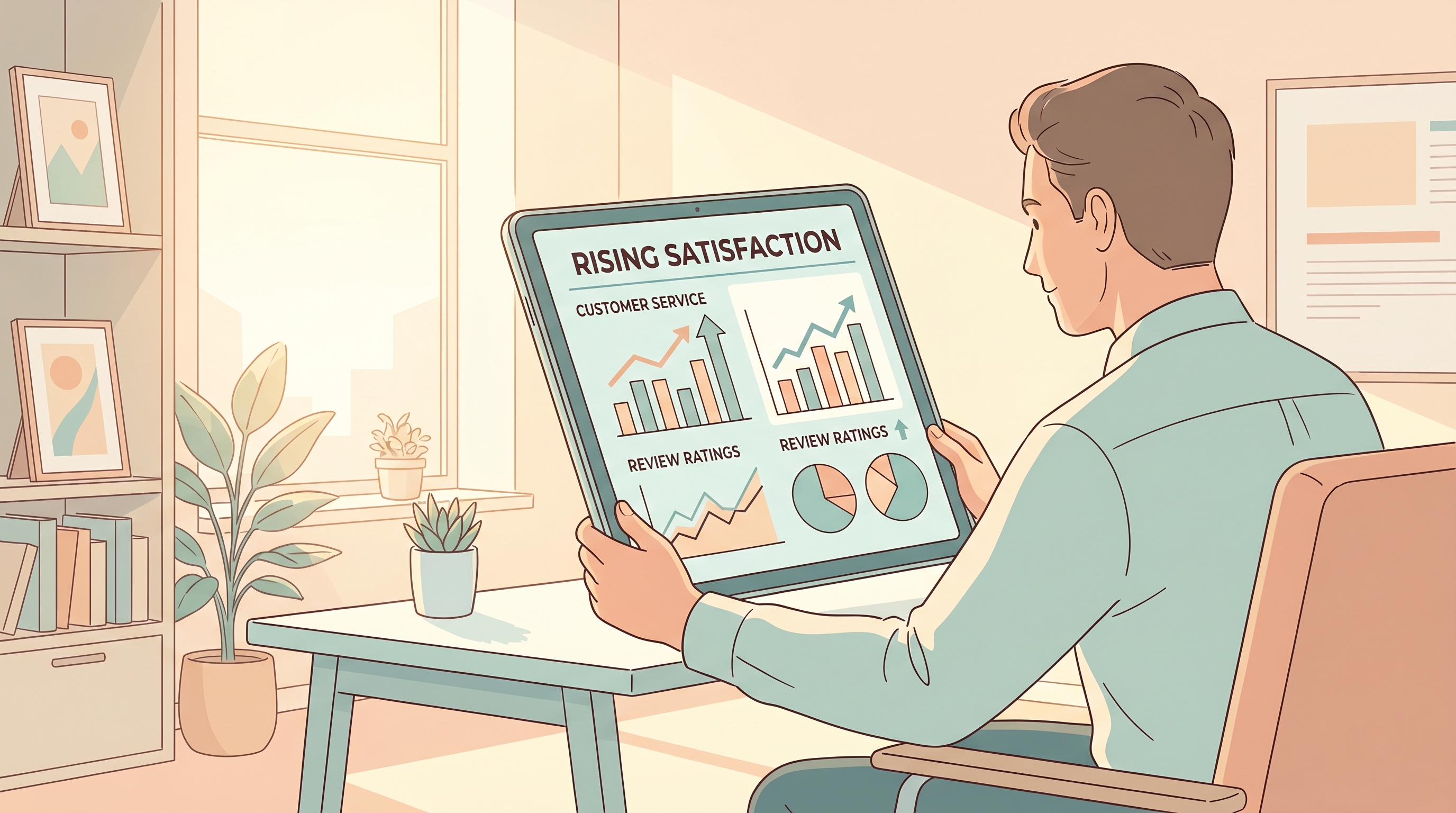
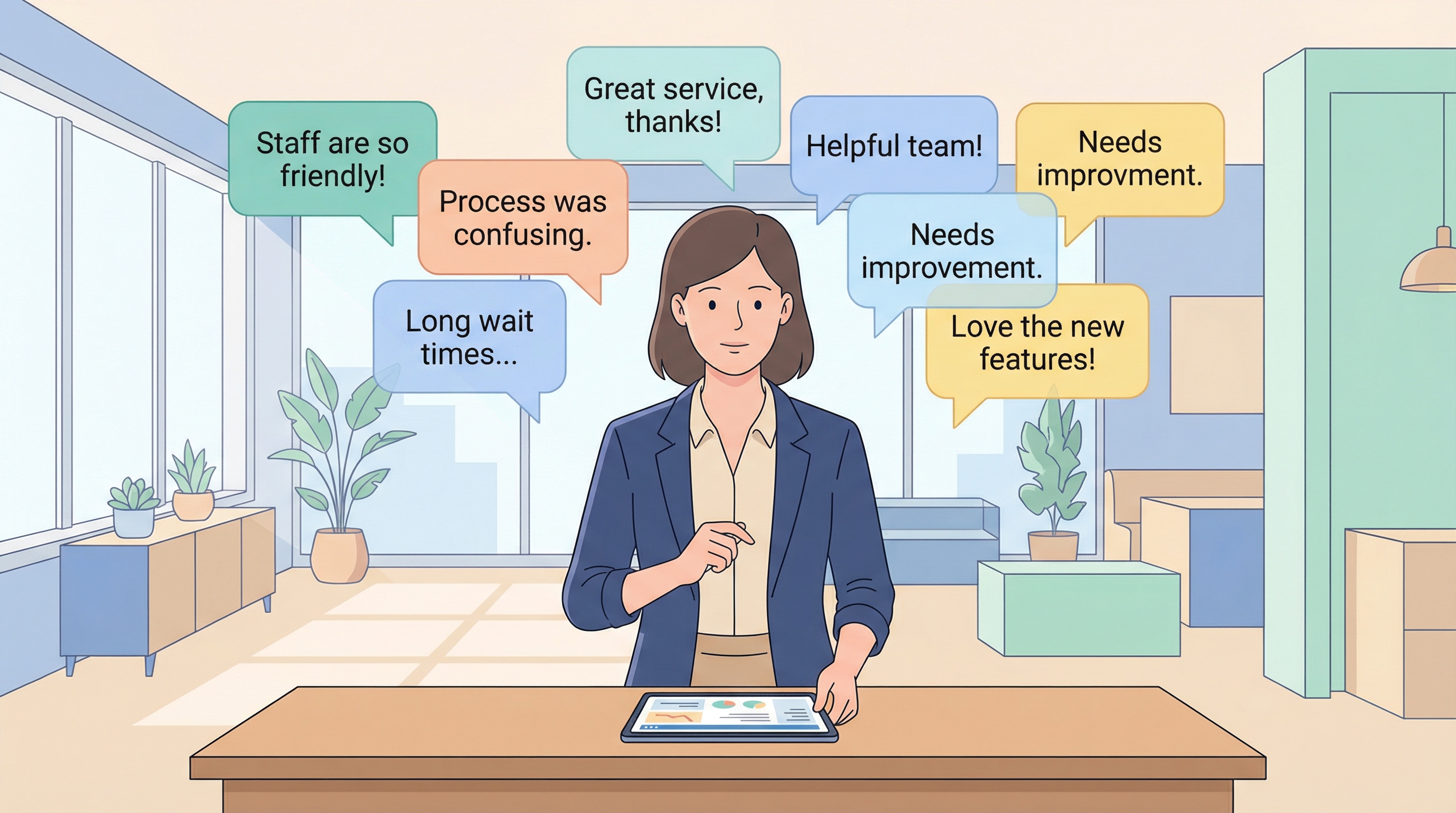
Sentiment analysis goes beyond star ratings. A 4-star review might contain a glowing paragraph about your staff and a sharp complaint about parking. A 3-star review might be entirely neutral—neither enthusiastic nor critical. Understanding the percentage breakdown of positive, neutral, and negative sentiment across your entire review corpus gives you a far more nuanced picture than your average star rating alone.
Why it matters: According to research from Harvard Business School, a one-star increase in a Yelp rating can lead to a 5–9% increase in revenue for independent restaurants. But that average rating is a blunt instrument. Sentiment analysis tells you why you're at 4.2 instead of 4.5—and what specific changes could close that gap.
2. Thematic and Category Analysis
Every business operates across multiple dimensions: service quality, product quality, value for money, overall experience, cleanliness, wait times, and more. Thematic analysis groups review content into these categories and scores each one independently.
For example, a dental practice might discover:
- Staff friendliness: mentioned positively in 78% of reviews
- Wait times: mentioned negatively in 34% of reviews
- Billing transparency: mentioned negatively in 22% of reviews
- Treatment quality: mentioned positively in 81% of reviews
This kind of breakdown immediately tells the practice owner where to focus. Treatment quality and staff are strengths to promote. Wait times are the most impactful area for improvement.
3. Trend Analysis Over Time
A snapshot of your reviews tells you where you are. A trend analysis tells you where you're heading. By tracking monthly average ratings and sentiment over the past 12 months, you can identify:
- Seasonal patterns — Do ratings dip during your busiest months (suggesting capacity strain)?
- Impact of changes — Did that new hire, menu change, or renovation move the needle?
- Early warning signs — Is a gradual decline in one category signaling a growing problem?
Trend data transforms reviews from a reactive tool ("someone complained, let's fix it") into a proactive management instrument.
4. Industry Benchmarking
Your 4.3-star average on Google means very little in isolation. Is that good for your industry? Are you above or below the median? How do you compare to the 75th percentile of businesses in your category?
Benchmarking contextualizes your performance. A 4.3 rating might place you well above the median for auto repair shops but slightly below average for day spas. Without that context, you can't accurately assess your competitive position or set realistic improvement targets.
Robust benchmarking requires large datasets. For reference, meaningful industry benchmarks typically draw from thousands of establishments and millions of reviews across dozens of business categories—the kind of dataset individual business owners simply can't compile on their own.
5. Customer Journey Mapping
Advanced review analysis can map sentiment to different stages of the customer journey: discovery and first impression, the purchase or service experience, and post-purchase follow-up. This reveals exactly where your customer experience breaks down.
A boutique hotel might find that pre-arrival communication scores extremely high, the in-room experience is strong, but the checkout process generates consistent frustration. That's a specific, fixable insight that a simple star rating would never reveal.
How to Actually Use These Insights
Data without action is just trivia. Here's how to translate review analytics into operational and strategic decisions:
Quick Wins (Implement Within 30 Days)
- Identify the single most-mentioned complaint in negative reviews. If 30% of your 1- and 2-star reviews mention the same issue, fixing it could meaningfully shift your overall rating.
- Double down on proven strengths in your marketing. If customers consistently praise your "friendly staff" or "fast turnaround," those phrases should appear in your Google Business Profile, website copy, and advertising.
- Train staff on specific pain points. If reviews reveal that front-desk interactions are a weak spot, that's a targeted training opportunity—not a vague "improve customer service" directive.
Strategic Initiatives (1–6 Months)
- Invest based on data, not assumptions. If your category performance shows that "value perception" is your weakest area, the answer might not be lowering prices—it might be better communicating what's included in your service.
- Set measurable goals tied to review metrics. Instead of "get better reviews," aim for "reduce negative mentions of wait times from 34% to 20% within six months."
- Use competitive mentions to refine positioning. If customers switching from a competitor consistently mention a specific reason, that's your unique selling proposition—straight from the market's mouth.
Ongoing Discipline
- Review your analytics quarterly. Customer expectations evolve. What was a strength six months ago might be table stakes today.
- Share insights with your team. When staff can see direct customer quotes tied to specific issues, feedback becomes concrete and motivating rather than abstract.
- Track the impact of changes. After implementing a fix, monitor whether the relevant review themes shift in subsequent months.
The ROI of Review Analytics for Small Businesses
Let's talk numbers. According to BrightLocal's 2024 Local Consumer Review Survey:
- 87% of consumers read online reviews for local businesses
- 73% of consumers only pay attention to reviews written in the last month
- 49% of consumers trust online reviews as much as personal recommendations from friends and family
Meanwhile, research from the Spiegel Research Center at Northwestern University found that displaying reviews can increase conversion rates by up to 270%. The impact is even greater for higher-priced products and services.
The implication is clear: your reviews directly influence revenue. Understanding what drives those reviews—and systematically improving the customer experience based on that understanding—is one of the highest-ROI activities a small business can invest in.
Yet most small business owners interact with their reviews one at a time, reading individual comments and reacting emotionally. That's like trying to understand the stock market by looking at one trade at a time. The value is in the aggregate patterns, the trends, and the benchmarked context.
Bridging the Gap: Professional Review Analytics on a Small Business Budget
The good news is that you don't need an enterprise budget to get enterprise-quality insights from your reviews. AI has fundamentally changed what's possible.
At Zabble Insights, we built our platform specifically to solve this problem. We use AI-powered analysis to examine up to 300 of your Google reviews (and optionally your Yelp reviews) and deliver a professional Word document report with everything discussed in this article: sentiment analysis, thematic breakdowns, monthly trend data, industry benchmarking drawn from a dataset of approximately 4 million reviews across 22 business categories, customer journey mapping, a customer priority matrix with direct quotes, and prioritized strategic recommendations.
Each report is a comprehensive one-time analysis—a detailed snapshot of your business's customer perception, benchmarked against your industry, with specific and actionable recommendations. Reports start at $99 per business, with an optional Yelp add-on for $25. You can explore sample reports across multiple industries to see exactly what's included.
This is the kind of data-driven decision-making that used to be reserved for businesses with dedicated analytics teams. Now it's accessible to any business owner who wants to stop guessing and start knowing.
Frequently Asked Questions
What kind of data can small businesses get from Google and Yelp reviews?
Google and Yelp reviews contain rich, structured data including star ratings, written customer feedback, timestamps, and thematic content about specific aspects of your business like service quality, pricing, wait times, and staff interactions. When analyzed in aggregate—typically 80 to 300 reviews—this data reveals sentiment trends, category-level performance scores, competitive positioning, customer journey pain points, and actionable patterns that individual review reading simply cannot surface. Combined with industry benchmarking, review data can answer the same strategic questions that enterprise companies spend tens of thousands of dollars to investigate.
How many reviews does a small business need for meaningful analytics?
Generally, 80 or more reviews provide enough data for statistically meaningful pattern recognition. Businesses with 150 to 300 reviews get the richest analysis, as the larger dataset allows for more reliable trend identification, more granular thematic breakdowns, and higher confidence in the findings. If your business has fewer than 80 reviews, the analysis can still provide useful directional insights, but the patterns should be interpreted with more caution. Most established local businesses with a few years of operation have accumulated enough Google reviews to support a thorough analysis.
How is AI-powered review analysis different from just reading my reviews?
Reading reviews individually gives you anecdotes. AI-powered analysis gives you patterns. When a human reads 200 reviews, they tend to remember the most recent ones, the most emotional ones, and the ones that confirm their existing beliefs—a well-documented cognitive bias. AI analysis processes every review equally, quantifying how frequently specific themes appear, tracking sentiment shifts over time, scoring performance across multiple categories simultaneously, and benchmarking results against industry data. The result is an objective, comprehensive picture of your customer experience that no amount of manual reading can replicate.
Can review analytics actually help increase revenue for a small business?
Yes, and the research supports this strongly. Studies from Harvard Business School show that a one-star rating improvement on Yelp can correlate with a 5–9% revenue increase for independent businesses. Research from Northwestern University's Spiegel Research Center found that reviews can increase conversion rates by up to 270%. Review analytics helps you identify the specific, highest-impact changes that will improve your ratings and customer perception. By pinpointing exactly which operational issues appear most frequently in negative reviews and which strengths resonate most with customers, you can prioritize investments that directly influence how new customers perceive and choose your business.