When was the last time you typed a question into Google and actually clicked on one of the blue links? If you're like a growing number of consumers, the answer is: not recently. Instead, you're getting your answers directly — from ChatGPT, Google's AI Overviews, Bing Copilot, or Perplexity. And those AI-generated answers are increasingly shaping how people discover, evaluate, and choose businesses like yours.
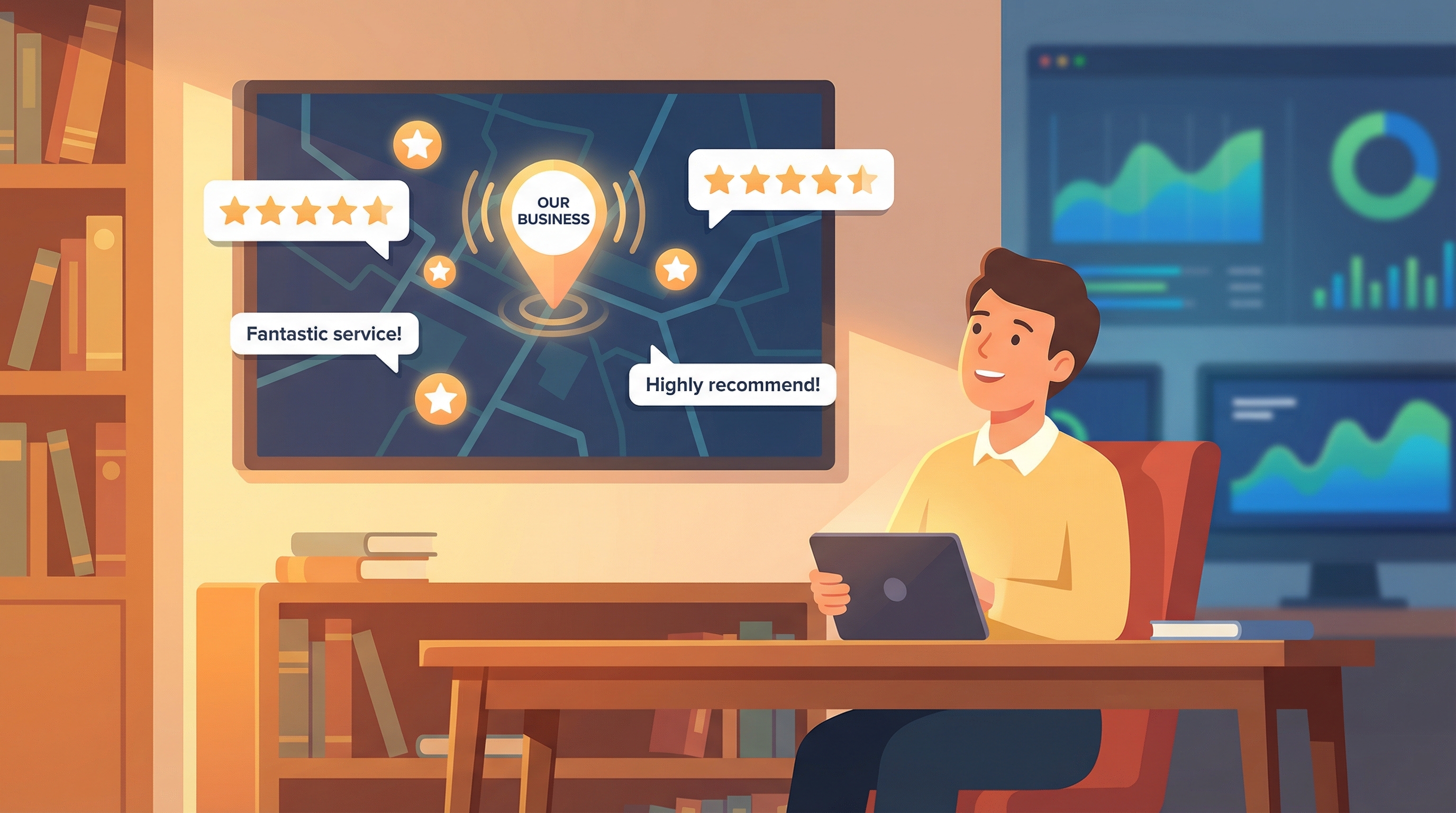
Here's the uncomfortable truth: the content that feeds these large language models (LLMs) doesn't come from your carefully crafted website copy or your latest Instagram post. It comes, in large part, from your customer reviews. What people have said about you on Google and Yelp is becoming the raw material for the AI-generated summaries that potential customers see — often before they ever visit your website.
This shift isn't coming. It's already here. And business owners who understand it will have a significant advantage over those who don't.
The Seismic Shift: From Search Engines to Answer Engines
Traditional search engines presented you with a list of links and let you decide where to click. LLMs do something fundamentally different: they synthesize information from multiple sources and present a single, conversational answer. The user never needs to click through to anything.
The numbers tell the story:
- Gartner predicted that traditional search engine volume would drop 25% by 2026 due to AI chatbots and virtual agents (Gartner, 2024).
- Google's AI Overviews now appear for a significant portion of search queries, summarizing information directly in the search results page.
- ChatGPT reached over 200 million weekly active users as of late 2024 (OpenAI), and a growing percentage of those interactions involve local business discovery and recommendation queries.
- A 2024 survey by Brightlocal found that 87% of consumers used Google to evaluate local businesses, with reviews being the primary content they consumed.
What does this mean for your business? When someone asks an LLM, "What's the best Italian restaurant near downtown?" or "Which dentist in my area has the shortest wait times?" the model doesn't browse the internet in real time. It draws on its training data — which includes massive amounts of publicly available review content from platforms like Google and Yelp — and generates an answer.
Your reviews are speaking for you in conversations you never see.
How LLMs Use Your Review Content
Understanding the mechanics helps clarify the stakes. Here's how your Google and Yelp reviews feed into LLM-generated answers:
1. Training Data Ingestion
LLMs are trained on enormous datasets that include publicly available web content. Google and Yelp review pages are part of the publicly crawlable web. The themes, sentiments, and specific language patterns from your reviews become embedded in the model's understanding of your business.
2. Retrieval-Augmented Generation (RAG)
Many modern AI search tools (including Google's AI Overviews and Perplexity) use RAG — a technique where the model retrieves fresh, relevant content at query time and uses it to generate answers. This means your most recent reviews can directly influence what the AI says about you, even if they weren't part of the original training data.
3. Sentiment Aggregation
LLMs don't just count stars. They understand language. If dozens of reviewers mention "long wait times" or "friendly staff" or "overpriced appetizers," the model picks up on those patterns and weaves them into its responses. The specific words your customers use become the specific words the AI uses to describe your business.
4. Comparative Ranking
When an LLM is asked to recommend "the best" of something, it's implicitly comparing businesses. The volume, recency, and sentiment of your reviews — relative to competitors — influences whether you appear in that recommendation or get passed over entirely.
Why This Changes Everything About Online Reputation
Traditional SEO taught business owners to optimize their websites: keywords, meta descriptions, backlinks, page speed. Those things still matter, but they're no longer sufficient. In an LLM-driven discovery landscape, the most influential content about your business is content you didn't write — your customer reviews.
This creates both a challenge and an opportunity:
The Challenge
- You don't control the narrative. LLMs synthesize customer language, not your marketing language.
- Negative patterns compound. A recurring complaint in reviews doesn't just hurt your star rating — it becomes part of how AI describes your business to thousands of potential customers.
- Stale reviews create stale impressions. If your most recent reviews are months old, the AI may rely on outdated perceptions of your business.
- You can't see the conversation. Unlike a Google search result you can track, you often have no visibility into how an LLM is characterizing your business.
The Opportunity
- Authentic customer language is powerful. When real customers consistently praise specific aspects of your business, LLMs amplify that praise.
- Operational improvements show up fast. Fix a recurring issue, and as new positive reviews roll in, the AI's characterization of your business evolves.
- Specificity wins. LLMs favor businesses with rich, detailed review content over those with sparse, generic reviews.
- Benchmarking against your industry reveals gaps. Understanding how your review profile compares to competitors and industry standards helps you prioritize what to fix.
Five Steps to Ensure Accurate, Positive AI Representation
So what can you actually do about this? Here's a practical framework:
Step 1: Audit Your Review Content Systematically
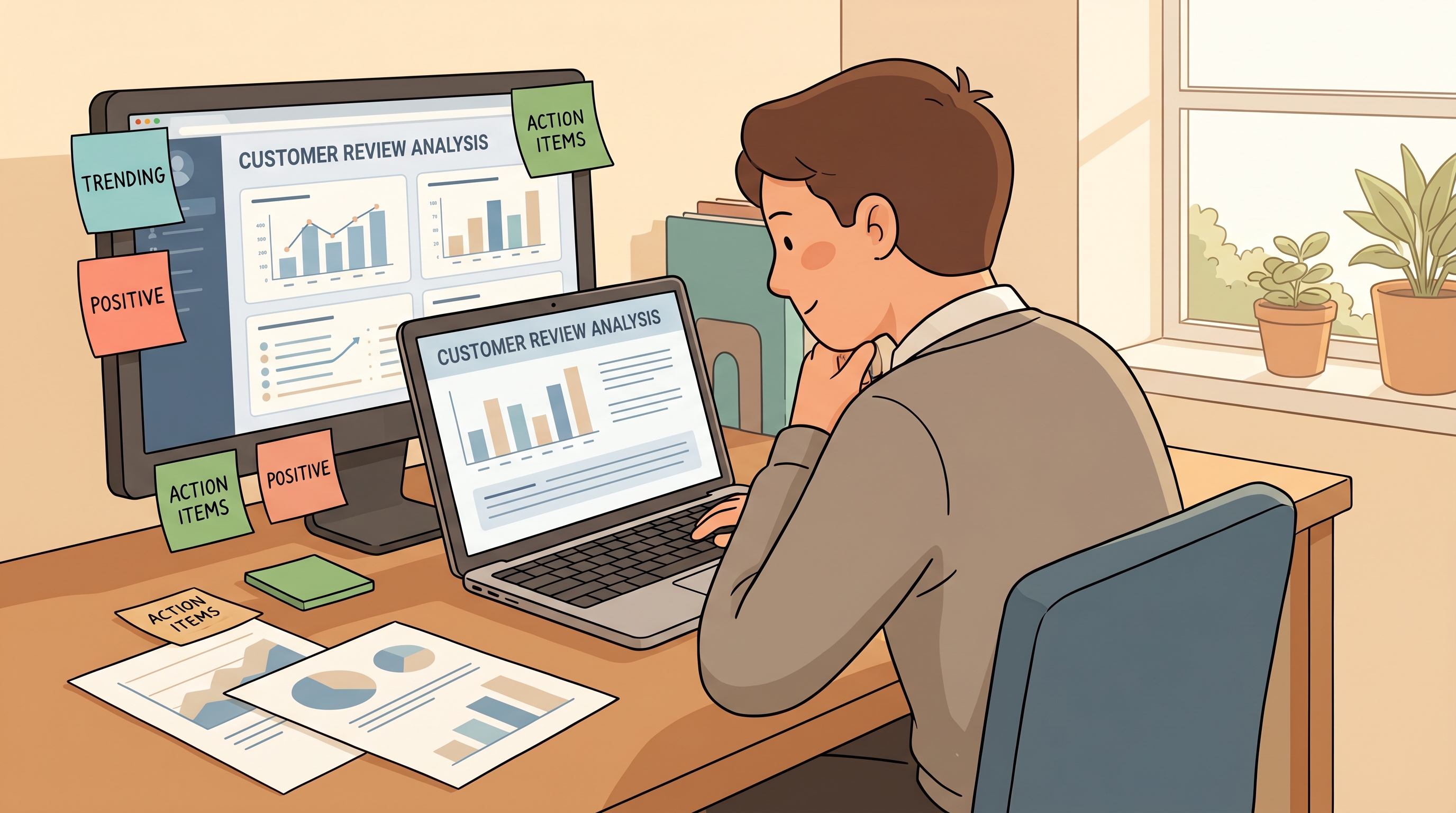
Don't just glance at your star rating. Dig into the themes, language patterns, and sentiment trends across your Google and Yelp reviews. Ask yourself:
- What are the three most frequently mentioned strengths?
- What are the three most common complaints?
- Has sentiment improved or declined over the past 12 months?
- What specific words and phrases do customers use most often?
This kind of thematic analysis is exactly what LLMs do when they encounter your reviews. You need to understand what the AI is "seeing."
Step 2: Address Recurring Negative Themes Operationally
This is the most important step, and there are no shortcuts. If 30% of your reviews mention slow service, no amount of marketing will override that signal in an LLM's synthesis. You need to actually fix the problem.
Prioritize issues by:
- Frequency: How often does this complaint appear?
- Severity: How much does it impact the customer experience?
- Recency: Is this getting better or worse over time?
Once you've made operational improvements, the new reviews that follow will gradually shift the AI's understanding of your business.
Step 3: Encourage Detailed, Specific Reviews
Generic five-star reviews ("Great place!") are less valuable in an LLM context than detailed ones ("The staff remembered my name from my last visit, and the new seasonal menu was outstanding — especially the butternut squash ravioli"). Specific, descriptive language gives the AI more to work with when generating recommendations.
You can encourage this by:
- Asking customers about specific aspects of their experience
- Making the review process easy and timely (ask shortly after the experience)
- Responding to detailed reviews to signal that you value that kind of feedback
Step 4: Respond to Reviews Strategically
Your responses to reviews are also part of the public record that LLMs can access. Thoughtful, professional responses to both positive and negative reviews accomplish several things:
- They add context that the AI can incorporate
- They demonstrate responsiveness and professionalism
- They can correct factual inaccuracies in negative reviews
- They signal to potential customers (and AI models) that you're an engaged, caring business owner
Step 5: Benchmark Against Your Industry
Your reviews don't exist in a vacuum. When an LLM compares businesses, it's implicitly comparing review profiles. Understanding where you stand relative to your industry — in terms of average rating, review volume, sentiment distribution, and category performance — helps you identify your true competitive advantages and vulnerabilities.
For example, if the median rating for restaurants in your category is 4.2 and you're at 4.0, you know exactly how much ground you need to make up. If your service scores are above the 75th percentile but your value perception is below average, you have a clear strategic direction.
The Data Behind the Shift: What Review Analysis Reveals
Across industries, certain patterns consistently emerge when you analyze large volumes of Google and Yelp reviews:
- Service quality is the single most mentioned category across nearly all business types, appearing in 40-60% of reviews.
- Value perception is the most polarizing — it drives both the strongest praise and the harshest criticism.
- Recency bias is real. Reviews from the last 6 months carry disproportionate weight in shaping current perceptions, both for human readers and AI models.
- Response rates matter. Businesses that respond to at least 50% of their reviews tend to have higher overall ratings and more positive sentiment trends.
These patterns aren't just academic. They're the exact signals that LLMs pick up on when generating answers about your business.
The Bottom Line: Your Reviews Are Your AI Profile
Think of your collective review content across Google and Yelp as your AI profile — the version of your business that large language models know and describe to potential customers. Unlike your website, which you control completely, this profile is built entirely from customer experiences and perceptions.
That's actually a powerful thing, if you're intentional about it. Businesses that deliver excellent experiences, encourage detailed feedback, respond thoughtfully, and continuously improve based on customer input will be the ones that LLMs recommend. It's the ultimate meritocracy — the AI doesn't care about your ad budget or your follower count. It cares about what your customers actually say.
How Zabble Insights Can Help
Understanding what your reviews actually say — beyond the star rating — is the critical first step. Zabble Insights provides AI-powered analysis of your Google and Yelp reviews, delivering a comprehensive professional report that includes sentiment breakdowns, thematic analysis, category performance scores, monthly trend tracking, and a customer priority matrix that ranks issues by frequency and severity with direct customer quotes.
Each report benchmarks your business against industry data drawn from over 4 million reviews across 22 business categories, so you can see exactly where you stand relative to your competition. It's a one-time, in-depth snapshot — not another subscription to manage — designed to give you the actionable insights you need to improve your review profile and, by extension, how AI represents your business.
Reports start at $99 for Google review analysis, with an optional Yelp add-on for $124 total. You can explore sample reports across multiple industries at zabbleinsights.com.
Frequently Asked Questions
How do LLMs use my Google and Yelp reviews to describe my business?
Large language models are trained on publicly available web content, which includes Google and Yelp review pages. They identify recurring themes, sentiment patterns, and specific language from your reviews. When users ask the AI about businesses like yours, the model synthesizes these patterns into its response. Some AI tools also use retrieval-augmented generation (RAG) to pull in recent review content at query time, meaning your newest reviews can directly influence AI-generated answers.
Can I control what an LLM says about my business?
You can't directly edit an LLM's output, but you can influence it significantly by improving the underlying review content it draws from. This means addressing recurring operational issues that generate negative reviews, encouraging satisfied customers to leave detailed, specific reviews on Google and Yelp, and responding thoughtfully to both positive and negative feedback. Over time, as your review profile improves, the AI's characterization of your business will shift accordingly.
How is LLM-driven discovery different from traditional Google search for local businesses?
Traditional Google search presents a list of links and lets the user click through to evaluate businesses. LLM-driven discovery (including Google's AI Overviews, ChatGPT, and Perplexity) synthesizes information and presents a direct answer or recommendation. This means users may choose a business based on the AI's summary without ever visiting your website. Your review content — the themes, sentiment, and specific language customers use — becomes far more influential than your website SEO in this new paradigm.
What's the most important thing I can do right now to improve how AI represents my business?
Start by understanding what your reviews actually say at a thematic level. Don't just look at your star rating — analyze the recurring themes, sentiment trends, and specific language patterns across your Google and Yelp reviews. Identify your top strengths (so you can amplify them) and your most frequent complaints (so you can address them operationally). The businesses that will win in LLM-driven discovery are those that consistently deliver excellent experiences and generate detailed, positive review content as a result.