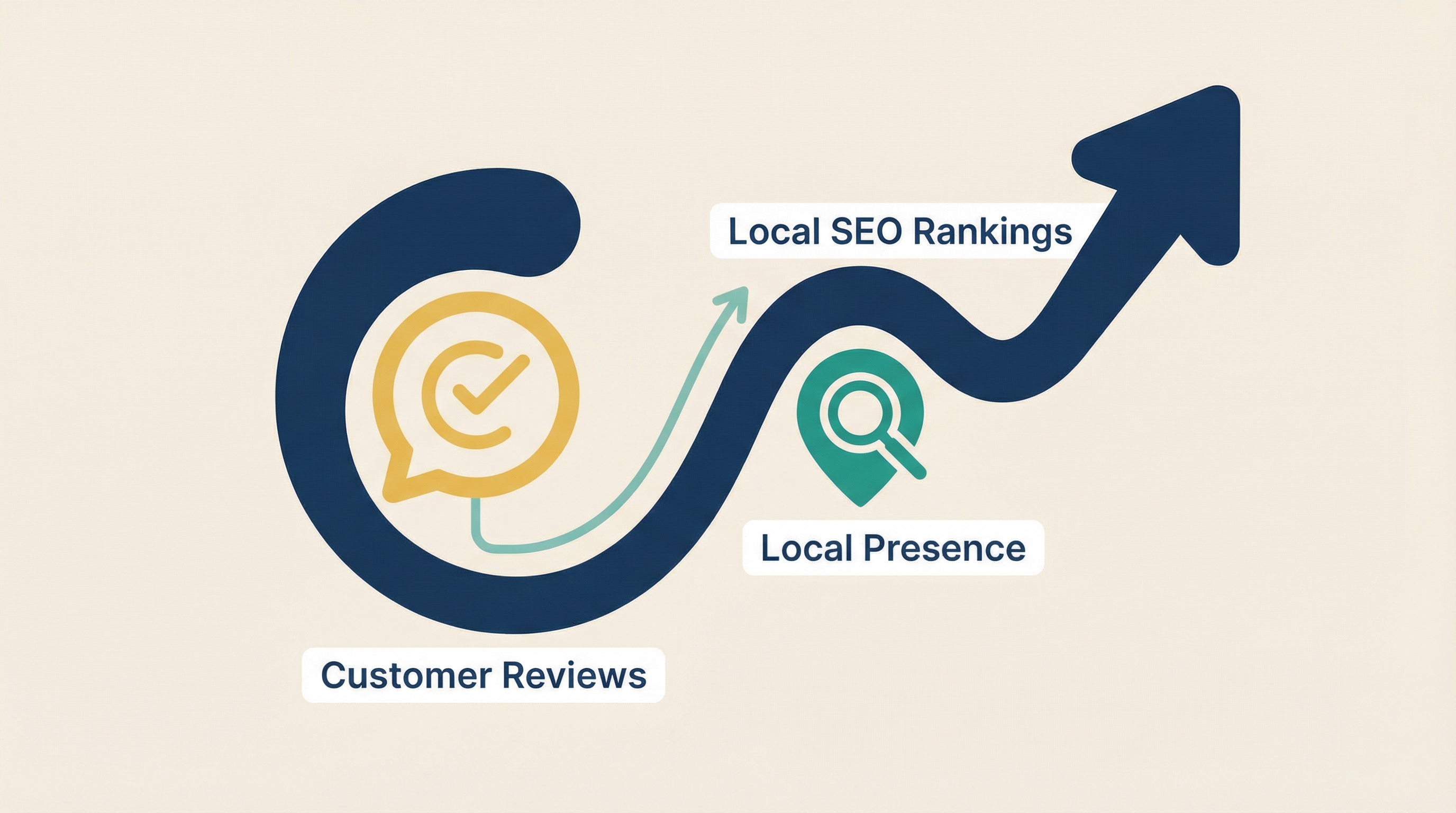
If you've ever wondered why the auto repair shop down the street consistently outranks yours on Google Maps — despite your better prices and friendlier staff — the answer might be sitting right in front of you. It's not their website. It's not their ad budget. It's their reviews. In 2026, customer reviews have become one of the most powerful levers in local search engine optimization, and most business owners are still treating them as little more than digital word-of-mouth. The truth is far more strategic: Google is reading your reviews with the sophistication of an AI analyst, and what it finds there directly shapes where you appear in local search results.
Understanding this connection — and learning how to analyze your own review content for SEO insights — can be the difference between showing up in the coveted Local Pack or languishing on page two where nobody looks.
The Local SEO Landscape in 2026: Reviews Are Non-Negotiable
Local SEO has always been a multi-factor game involving Google Business Profile optimization, citation consistency, backlinks, and on-page signals. But in recent years, the weight of review signals has grown substantially.
According to Whitespark's annual Local Search Ranking Factors survey, review signals have consistently ranked among the top three factors influencing Local Pack rankings. By the 2023 edition, review signals accounted for approximately 17% of Local Pack ranking factors — and that number has only increased as Google's natural language processing capabilities have improved. BrightLocal's 2024 Local Consumer Review Survey found that 87% of consumers read online reviews for local businesses, and 98% of consumers read reviews at least occasionally.
Google itself has become more transparent about this. Their own documentation states that reviews factor into local search prominence, noting that "Google review count and review score factor into local search ranking." But that's just the surface. Beneath Google's simple statement lies a sophisticated system that evaluates multiple dimensions of your review profile.
The Four Pillars of Review-Based SEO Signals
Google's algorithm evaluates reviews across at least four critical dimensions:
- Volume — The total number of reviews your business has accumulated
- Recency — How frequently new reviews are being posted
- Sentiment — The overall star rating and the emotional tone within review text
- Keywords — The specific words and phrases customers use to describe your business
Each of these pillars contributes to your local search visibility in distinct ways. Let's break them down.
Review Volume: Why More Reviews Mean More Visibility
The correlation between review count and local search rankings is well-documented. A study by Semrush analyzing local search results found that businesses in the top three positions of the Local Pack had significantly more reviews than those ranked lower. The median review count for top-ranking local businesses often exceeds 100, while businesses with fewer than 20 reviews struggle to compete in moderately competitive markets.
But volume isn't just about hitting a magic number. It's about what a healthy review count signals to Google:
- Business legitimacy — A business with hundreds of reviews is clearly established and active
- Consumer trust — Higher review counts correlate with higher click-through rates from search results
- Data confidence — More reviews give Google more data to accurately categorize and rank your business
What This Means for Your Strategy
- Aim to consistently accumulate reviews rather than pursuing them in bursts
- Focus on making the review process easy for satisfied customers
- Don't ignore Yelp — while Google Reviews carry the most weight for Google's local rankings, a strong presence on Yelp reinforces your overall online reputation and can influence consumer behavior during the decision-making process
Review Recency: The Freshness Factor
A business with 500 reviews that hasn't received a new one in six months sends a very different signal than a business with 200 reviews that gets three new ones every week. Google prioritizes recency because it indicates that a business is currently active and delivering experiences worth commenting on.
BrightLocal's research has shown that 73% of consumers only pay attention to reviews written in the last month. Google's algorithm appears to share this preference. Fresh reviews suggest:
- The business is still operating and serving customers
- The quality signals from reviews reflect the current state of the business
- The business has ongoing customer engagement
The Velocity Sweet Spot
Review velocity — the rate at which new reviews arrive — matters as much as total count. A sudden spike of 50 reviews in a week can actually trigger Google's spam filters. What you want is a steady, organic cadence of new reviews. For most local businesses, 2-5 new Google reviews per week represents a healthy, sustainable velocity that signals ongoing customer activity without raising red flags.
Review Sentiment: Star Ratings and Beyond
Your average star rating is the most visible sentiment signal, and it matters enormously. Google uses star ratings as both a ranking factor and a display element — those gold stars in search results directly influence click-through rates. Research from Search Engine Journal has indicated that businesses with ratings below 4.0 stars see measurably lower click-through rates from local search results.
But in 2026, Google's AI goes far deeper than star ratings. Google's natural language processing can now evaluate the emotional tone and specificity of review text. A five-star review that says "Great place!" carries less weight than a five-star review that says "The team replaced my transmission in two days, kept me updated the whole time, and the price was exactly what they quoted."
The Sentiment Spectrum
Here's how sentiment analysis breaks down from a local SEO perspective:
- Positive sentiment with specifics — The strongest signal. Detailed praise tells Google what your business excels at and helps match you to relevant search queries
- Positive sentiment without specifics — Helpful for star rating averages but provides limited keyword and categorization value
- Neutral sentiment — Neither helps nor hurts significantly, but a high percentage of neutral reviews may indicate a lack of differentiation
- Negative sentiment with specifics — Can actually help Google understand your business category, but obviously hurts your rating and consumer perception
- Negative sentiment without specifics — The least useful signal; vague complaints like "Terrible experience" provide no actionable data for anyone
Understanding the distribution of sentiment across your reviews — what percentage are positive, neutral, and negative, and what specific themes drive each category — is essential for both SEO and operational improvement.
Review Keywords: The Hidden SEO Goldmine
This is where most business owners miss the biggest opportunity. The specific words and phrases your customers use in their reviews function as organic keyword signals that help Google understand what your business does, what it's known for, and which search queries it should appear for.
When a customer writes, "Best deep-dish pizza in downtown Denver," they've just provided Google with:
- A product keyword ("deep-dish pizza")
- A geographic signal ("downtown Denver")
- A superlative quality signal ("best")
This is essentially free, user-generated SEO content that lives on your Google Business Profile — one of the most authoritative properties in local search.
How Review Keywords Influence Rankings
- Category reinforcement — Reviews that mention your core services confirm Google's understanding of your business category
- Long-tail query matching — Specific phrases in reviews can help you rank for niche searches (e.g., "emergency plumber on weekends" or "gluten-free birthday cakes")
- Local relevance — Mentions of neighborhoods, landmarks, and city names strengthen your geographic relevance
- Service/product discovery — Reviews that mention services you offer but haven't highlighted in your profile can expand the queries you appear for
A 2023 study by Sterling Sky found that businesses whose reviews contained keywords matching search queries were more likely to appear in relevant local results, even when other ranking factors were comparable. This effect has only intensified as Google's language models have become more sophisticated.
Analyzing Your Review Keywords
To leverage this, you need to understand what customers are actually saying in your reviews:
- Which products or services are mentioned most frequently? These are your perceived strengths
- Which keywords appear in your highest-rated reviews? These represent your competitive advantages
- Which terms appear in negative reviews? These highlight areas where customer expectations aren't being met
- Are customers using geographic terms? This can inform your local content strategy
- Are there services you offer that customers never mention? This may indicate an awareness or marketing gap
Manually reading through hundreds of reviews to extract these patterns is theoretically possible but practically overwhelming for busy business owners. This is where systematic review analysis becomes invaluable.
Turning Review Insights into Local SEO Action
Understanding the theory is one thing. Translating review data into concrete SEO improvements is another. Here's a practical framework:
Step 1: Audit Your Current Review Profile
Before making changes, establish your baseline:
- Total review count on Google (and Yelp, if applicable)
- Average star rating
- Review velocity over the last 12 months
- Sentiment distribution (what percentage of reviews are positive, neutral, negative)
- Most frequently mentioned keywords and themes
Step 2: Identify Keyword Gaps and Opportunities
Compare the keywords customers use in your reviews with the search terms you want to rank for. If customers rave about your "same-day AC repair" but your Google Business Profile emphasizes "HVAC installation," you have a misalignment worth addressing.
Step 3: Optimize Your Google Business Profile
Use the language your customers actually use. If reviews consistently mention "friendly staff" and "quick turnaround," incorporate those phrases naturally into your business description and service listings. You're not stuffing keywords — you're aligning your profile with the authentic language of your customer base.
Step 4: Address Negative Themes Operationally
If negative reviews consistently mention long wait times, that's not just an SEO problem — it's a business problem. Fixing the operational issue will naturally improve future review sentiment, which in turn improves your review signals.
Step 5: Benchmark Against Competitors
Knowing your own review data is essential, but understanding how you compare to industry benchmarks and local competitors provides critical context. A 4.3-star rating might be excellent in one industry and mediocre in another.
How Review Analysis Supports Smarter SEO Decisions
The challenge for most local business owners isn't a lack of reviews — it's a lack of structured insight from those reviews. Reading individual reviews one at a time gives you anecdotes. Analyzing your entire review corpus gives you data-driven patterns that can inform your SEO strategy, your marketing messaging, and your operational priorities.
This is exactly the kind of analysis that Zabble Insights provides. By collecting and analyzing up to 300 of your Google Reviews (and optionally your Yelp reviews), Zabble's AI-powered platform identifies the specific themes, sentiment patterns, keyword clusters, and performance trends hidden in your review data. You receive a professional report with actionable recommendations — including the kind of thematic and keyword analysis that directly supports local SEO optimization. With industry benchmarks drawn from approximately 4 million reviews across 22 business categories, you can see exactly where you stand relative to your market. It's a one-time analysis snapshot that gives you a strategic foundation to build on, starting at $99 per business.
You can explore sample reports and industry benchmarks at zabbleinsights.com.
The Bottom Line
In 2026, your Google Reviews are not just social proof — they are active SEO assets that directly influence your visibility in local search. The volume, recency, sentiment, and keyword content of your reviews all send signals that Google uses to determine where you rank in the Local Pack and local organic results.
Business owners who treat reviews as a strategic data source — analyzing them for patterns, extracting keyword insights, and using those findings to optimize their online presence — will consistently outperform competitors who simply collect reviews and hope for the best.
The reviews are already there. The question is whether you're reading them the way Google does.
Frequently Asked Questions
How many Google Reviews does a local business need to rank in the Local Pack?
There's no universal minimum, as the required number depends on your market and competition. However, research consistently shows that businesses in the top three Local Pack positions tend to have significantly more reviews than lower-ranked competitors. In moderately competitive markets, businesses with 50-100+ reviews generally perform better in local search. More important than hitting a specific number is maintaining a steady flow of new reviews over time, as review velocity and recency are critical ranking signals alongside total volume.
Do the words customers use in Google Reviews actually affect local search rankings?
Yes. Google's natural language processing analyzes the text content of reviews, not just star ratings. When customers mention specific services, products, or geographic terms in their reviews, those keywords help Google understand what your business offers and match it to relevant search queries. For example, if multiple reviews mention "emergency roof repair" and someone searches for that term in your area, your business is more likely to appear. This makes review content a form of organic, user-generated SEO that can expand the range of search queries your business ranks for.
How does review sentiment impact local SEO beyond star ratings?
While your average star rating is the most visible sentiment signal, Google's AI also evaluates the emotional tone and specificity within review text. Detailed positive reviews that describe specific experiences carry more weight than generic praise. The sentiment distribution across your entire review profile — what percentage of reviews are positive, neutral, or negative — contributes to Google's assessment of your business quality and relevance. Consistently positive sentiment with specific details strengthens both your ranking signals and your click-through rates from search results.
How often should a local business analyze its review data for SEO insights?
For most local businesses, conducting a thorough review analysis quarterly provides a good balance between staying current and having enough new data to identify meaningful trends. Key moments to analyze your reviews include after launching a new service, following a significant operational change, during seasonal business shifts, or when you notice a change in your local search rankings. A structured analysis — examining keyword themes, sentiment trends, and performance benchmarks — provides far more actionable insight than simply reading reviews one at a time.